
Life and legacy · 30th anniversary
A people’s lawyer
An enduring figure in human and civil rights,
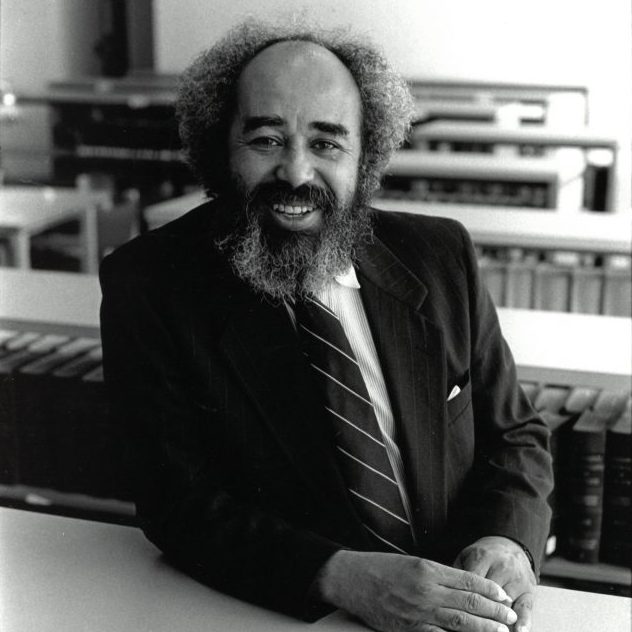
W. Haywood Burns was a founding force for CUNY Law’s mission and the legal profession’s evolution toward racial justice.
Chapter one
Community, education, and mobilization

Haywood’s political activism showed at age 15 when he helped integrate a swimming pool in his native Peekskill, New York. As a teenager, he joined the NAACP and became president of its junior branch; by the time he entered Harvard on scholarship, he had already developed a deep interest in history, racial justice, and the law. The emerging civil rights movement sharpened that commitment. At Harvard, Burns organized in support of Southern civil rights campaigns, and after studying at Cambridge University he published The Voices of Negro Protest in America in 1963, beginning a lifelong effort to understand how law could both sustain racial inequality and become a tool for challenging it.
“[Haywood Burns’] career cut across racial and ethnic lines, uniting politicians and persecutors, eager young attorneys and prosecutors, and grizzled civil rights veterans, the famous and the forgotten.”— David Gonzalez, The New York Times
Chapter two
Movement lawyering
Burns practiced law as part of movements for social and political change, not apart from them. While Assistant Counsel to the NAACP Legal Defense and Educational Fund, he also served as general counsel to Martin Luther King Jr.’s Poor People’s Campaign. Haywood founded and then became the first director of the National Conference of Black Lawyers, helping build what he described as a legal arm of the Black liberation struggle. He became the first African-American president of the National Lawyers Guild. His work placed him alongside organizers, protesters, incarcerated people, and communities confronting state power—from helping negotiate the creation of Resurrection City, to coordinating the defense of prisoners prosecuted after the Attica rebellion. His approach reflected a central principle of his career: law was not a neutral or sufficient remedy for injustice, but it remained a powerful tool when lawyers worked in partnership with communities and movements seeking structural change.

Chapter three
CUNY Law
As dean from 1987 to 1994, Burns cemented the Law School’s access mission and its commitment to law in the service of human needs.
The first Black dean of a law school in New York State, he led CUNY School of Law through the difficult process of securing permanent American Bar Association accreditation. He helped ensure the survival of its progressive public-interest mission, and mentored generations of students entering legal practice. For Burns, CUNY Law was not simply a place to train lawyers, but a way to reshape who could become a lawyer, whom lawyers would serve, and what legal education itself could accomplish.
Continuing influence
We share this part of his legacy knowing we still have so far to go before we will move away from what can, in fact, be painful celebrations of the “firsts” or “onlys” in fields requiring more anti-racism and anti-oppression work.
Chapter four
Global work
Burns understood the struggle for racial justice as fundamentally international. He led National Conference of Black Lawyers delegations to Cuba and the Caribbean and worked with the International Association of Democratic Lawyers in South Africa, Namibia, and Ireland. His deepest engagement was with the anti-apartheid movement, where he helped connect U.S. lawyers with African National Congress leaders and later advised on South Africa’s Interim Constitution. In 1994 he returned to South Africa as an election observer for the country’s historic democratic elections, an experience he described as among the most moving of his life.His global work reflected a conviction that struggles for justice were interconnected and strengthened through sustained solidarity across borders.
