
CUNY Law alumna brings lived experience, legal training, and policy work into one of the hardest questions facing the field of sex crimes
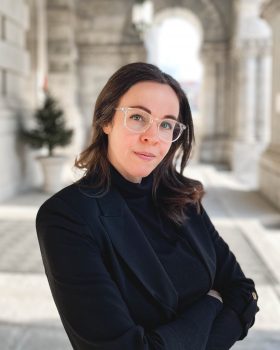
Brittney Frey ’22
Brittney Frey ’22 has spent her legal career asking a question that doesn’t have an easy answer: what does accountability look like in cases of serious harm?
She has approached this question from multiple angles—through writing and editing on the CUNY Law Review, through her own restorative justice process, and now through her work in policy.
Frey writes about restorative justice from a place where most legal scholarship does not begin.
Her recent publication in the ABA Journal draws on her lived experience going through a restorative justice process. This summer, she will speak about that work on a national stage, where conversations about sexual harm are still largely shaped by practitioners rather than the people most directly affected.
“In the rooms I entered, there were people talking about sexual harm,” she says. “But no one with lived experience was leading.”
Frey did not come to law school with a fully formed plan for how to change that. But she did arrive with a clear sense of why she was there.
“I don’t know exactly what my legal path will look like,” she remembers saying to a room full of classmates on her first day at CUNY Law, “but I want to be advocating for victims of child abuse and neglect.”
She had already written it in her personal statement. What was new was saying it plainly, in that setting, and saying the rest of it too: that she had been sexually abused as a child. That this wasn’t abstract. That this was the reason.
“Maybe that was too much, too soon,” she says now, with a soft smile. “But it was always the thread. I just didn’t know yet how it was going to show up in the law.”
Throughout Brittney’s time at CUNY School of Law, the question of what her work would look like did not get resolved so much as it got more precise. The Law School’s emphasis on experiential learning is often described in terms of clinics and hands-on practice, and that was part of it. But just as important to Brittney’s training at CUNY Law was the way lived experience was something that could guide the work itself.
Frey credits her work on CUNY Law Review for helping her translate her experiences and education into writing and advocacy that led to publications and presentations.
The work itself shifted her understanding of writing. One of the pieces she worked on as an editor, Restorative Justice in Cases of Sexual Harm, was a collaborative process.
The article argued that existing responses to sexual violence do not consistently reduce harm and often fail to offer survivors meaningful forms of accountability or repair. It proposed restorative justice as an approach that could be survivor-centered, trauma-informed, and responsive in ways the criminal legal system often is not. For Frey, working on the article was less about agreeing with every aspect of the argument and more about what it meant to sit inside a question that had not been settled.
Then the work moved beyond the page. As part of the Law Review’s 25th Anniversary celebration symposium, Frey initiated and co-moderated a panel on the article with then-Associate Dean of Student Affairs Rev. Dr. Yvette Wilson-Barnes, bringing the conversation into a room where it could be tested, challenged, and extended. It was one of the first times she saw how writing, convening, and public dialogue could function together.
That sense of where conversations were happening, and who was leading them, stayed with her after she graduated. A couple years later, Frey attended the National Conference on Community and Restorative Justice in Washington, D.C.. She went as a volunteer, which meant the ticket was complimentary, and she paid the rest of her way. Frey moved between sessions during the four-day conference, listening.
“I was moved by many of the sessions at the conference, especially the legislative and policy discussions. But I was surprised that it was so practitioner-heavy,” she says. “A lot of people doing the work, talking about the work.”
What she did not see were people speaking from lived experience of the kinds of harm being discussed, especially in sessions focused on sexual violence. That absence felt familiar, in a way that connected back to law school and forward into the work she has been doing since.
After going through her own restorative justice process, Brittney decided to propose something different. A panel that would center lived experience, not as testimony added onto a practitioner conversation, but as the frame itself. She did not assume it would be accepted. She applied anyway.
Months later, it was.
This summer, Brittney will present at the 10th National Conference on Community & Restorative Justice on July 8 in New Orleans alongside the facilitators who worked with her, speaking about the process itself and what it reveals about the current limits of restorative justice practice. Her recent publication in the ABA Journal traces that experience in more detail, writing from inside something that is often discussed at a distance. The piece sits somewhere between analysis and account, grounded in the specifics of what it means to participate in a process that is still not widely understood and often inaccessible.
Her path after law school has not followed a single line, though it has been consistent in its focus. She went to the Brooklyn District Attorney’s Office and began working as a prosecutor. It was, in some spaces, a complicated choice to explain.
“At CUNY, an interest in prosecution, even if you add the word progressive, is something you didn’t say out loud,” she says. “If you were interested in that career path, you kept it to yourself.”
For Brittney, it was less a departure than a continuation. Family law did not feel like the right fit, but she wanted to work on cases involving serious harm, particularly sexual violence and crimes against children. She wanted to see how the system functioned at that level, how decisions were made, how cases moved, what a different kind of justice might look like if it was truly accessible rather than a rarely available option.
“I wanted to see how the inside of the criminal legal system functioned in cases that were similar to my own. I was eager to learn what was working within the system, what wasn’t, and where my lived experience could fill the gaps.”
After serving in the Special Victims Bureau at the Brooklyn District Attorney’s Office, Frey moved into felony and grand jury practice before moving on to the Red Hook Community Justice Center, a court that has been cited nationally as a model for integrating rehabilitation and community-based responses into the legal process. It was there, she says, that the question she had been circling became harder to ignore.
“I have abolitionist values,” she says. “But I also kept asking, what do we do with serious harm?”
The question does not lend itself to quick answers. What she returns to, instead, is the sense that existing frameworks often force a narrowing. Either punishment or nothing. Either alignment or opposition. Restorative justice, as she understands it, is not a middle ground so much as a different set of demands. It asks more of everyone involved. It requires participation, acknowledgment, a willingness to stay with harm rather than move past it through procedure.
At Red Hook, she saw both the promise and the limits of that approach. The work was not consistently available. It depended on context, on people, on conditions that could not always be reproduced. If restorative justice was going to become something more than a set of isolated practices, it would have to be built into the structure of the law itself.
That realization is what brought her to her current role as Associate Counsel in the New York State Assembly. The move required tradeoffs, including a significant reduction in salary and relocation to Albany, but she understood it as a way to learn another layer to the law that she did not yet know.
“I wanted to understand how the infrastructure of our state’s highest level of government actually works,” she says. “How laws get made. How decisions get made.”
Her work now involves drafting and reviewing legislation, preparing assembly members for debate, and meeting with advocacy groups that are trying to move legislation and policy forward. It also involves sitting in the complexity of a state that is larger, and more politically varied, than New York City alone.
“Being upstate changes how you see things,” she says. “You hear arguments that are coming from completely different places.”
When she looks back at her time at CUNY Law, she does not describe it as a place that gave her a single path. What it offered was something more durable. A set of experiences and tools, yes, but also a set of tensions she has continued to work within.
She is now in conversation with the Law School about the possibility of developing a course in restorative justice, a proposal that would create space for students to engage the kinds of questions she found herself holding, often without a clear place to put them. Not to resolve those questions, but to make them legible, discussable, part of the curriculum rather than adjacent to it.
“I think there’s room for more conversation,” she says. “For more ways of thinking about harm and accountability that are not just punishment or nothing.”
The thread Frey named on her first day of law school is still there, still taking on new shapes and weaving together new avenues to approach the work through creative writing, practice, policy work, and now in the spaces she is helping to create for others.
Experience, in her case, is not something that sits behind the work. It is what keeps changing its direction.