How one upper-level offering turns theory into lived advocacy and prepares students for the realities of modern citizenship and immigration practice
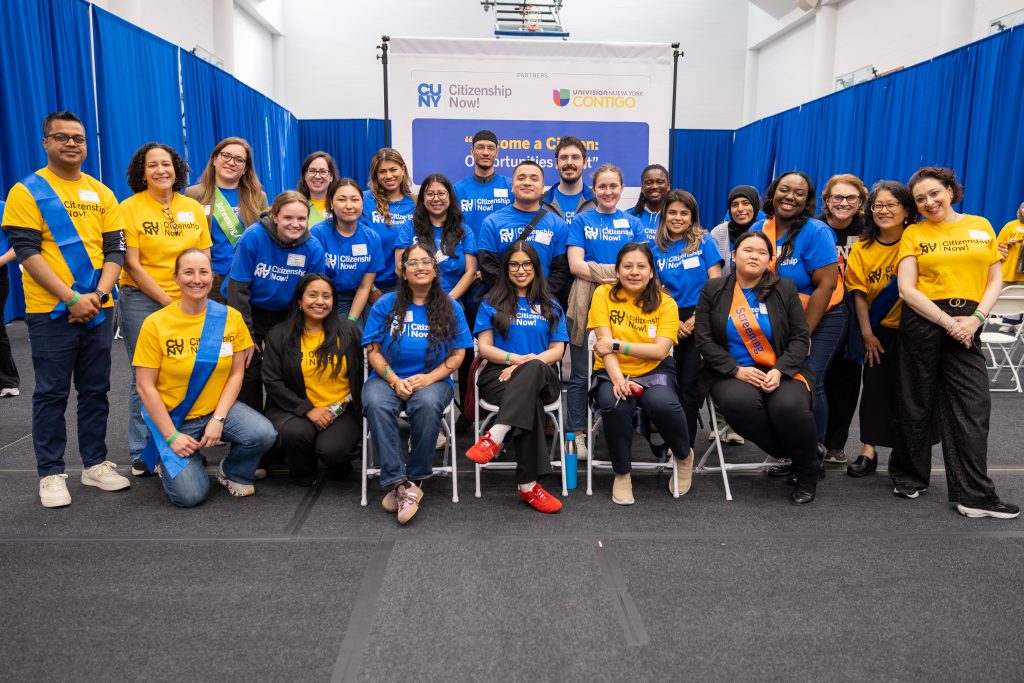
When Max Romero, Tenzin Choedon, and Taylor Share enrolled in Professors Janet Calvo and Tamara Bloom’s Citizenship and Immigration Practicum, they expected a rigorous academic exploration of immigration and citizenship policy. What they didn’t expect was how quickly they’d find themselves stepping into the work of real practitioners: analyzing shifting federal policy, supporting community-based naturalization events, and working directly with New Yorkers navigating complex immigration and citizenship systems. The Practicum—developed over years by Professor Calvo in partnership with alumna Tamara Bloom ’04, now Managing Attorney for Community Events, at CUNY’s Citizenship Now!—is a living example of CUNY Law’s founding commitment to producing practice-ready lawyers grounded in community, advocacy, and justice. In a single semester, students move from theory to policy analysis to hands-on lawyering under Calvo and Bloom’s guidance. The result is a course that pushes students to think like lawyers and act like advocates.
Designing a Different Kind of Legal Education
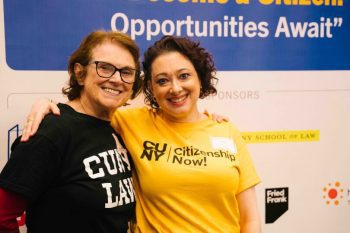
Professor Calvo’s vision for the practicum emerged from a clear pedagogical challenge: how to give students a real lawyering experience within a single semester. “Looking for a pedagogy that would allow a real-life experience that could be begun and finished in a short one semester endeavor—and that would challenge both their lawyering skills and their analytical capacity—is not an easy task,” Calvo explains.
A breakthrough came from partnership with Tamara Bloom, a former student of Professor Calvo’s. Together, they built a course and a collaboration between CUNY Law and CUNY Citizenship Now!, to integrate students into ongoing citizenship and immigration work in a way that was substantive, structured, and professionally meaningful.
“We were very interested in citizenship and immigration because they are such predominant issues” Calvo notes. “When I connected with Tamara, we focused on how to effectively integrate students into Citizenship Now! so they weren’t just ‘dropped in.’ The question was: how do you build a classroom component that gives students the legal grounding and skills to do the work well?”
This design reflects the pedagogical DNA Calvo helped establish at CUNY Law from the beginning. “When the Law School started, the themes were clear: pay attention to theory, pay attention to doctrine, and pay attention to the reality of practice,” she recalls. “And the teaching goals were learning, doing, and reflecting.”
Bloom underscores that the structure benefits students and the organization alike: “We found a way to have the students be integrated into the work—while being mindful they will be with us only for the semester.”
Professor Calvo’s Leadership and Legacy
A member of the faculty since the school’s earliest years, Professor Calvo helped shape the pedagogical commitments that still define the institution: rigorous attention to theory, deep engagement with doctrine and procedure, a focus on social justice and an opportunity for students to test their learning against the realities of practice. Her scholarship and teaching have focused on immigration, citizenship, and access to justice—areas where law shifts quickly and affects daily life. The Citizenship Practicum synthesizes hallmarks of CUNY Law’s curriculum: experiential learning, critical analysis, and community-rooted advocacy, and channels them into a model of professional preparation that will continue to shape students’ careers. Her partnership with Bloom reflects what CUNY has always done exceptionally well: build structures where students learn by doing, reflect meaningfully, and understand themselves as part of a larger project of legal and social change.
Using Real Materials
To prepare students for citizenship and immigration practice, Calvo and Bloom abandoned traditional casebooks and instead anchored the course in the materials practitioners consult daily. “We were very fortunate to be able to use resources Tamara secured—resources used to train lawyers,” Calvo explains.
Bloom details the practical focus of these materials: “We use no paid resources. Everything is free and publicly available: toolkits, practice guides, real documents that organizations share. Students get a lot of experience going straight to the USCIS website and reading what USCIS has to say and learning how practitioners stay current.”
This approach deliberately builds habits that will serve students throughout their careers. Students learn to read materials critically, cross-reference agency guidance, and navigate specialized resources from groups like the Immigrant Defense Project. As Bloom notes, “It gets them used to using resources that advocates use on a daily basis. It gets them to do a deeper dive when they research.”
Learning from Real Practitioners and Peers
Guest speakers from across the citizenship and naturalization landscape bring the practicum’s opics into sharper focus. “We had guest stars come in—people I work with who have specialized expertise,” Bloom says. Her dual role at Citizenship Now! creates efficiencies too: “I do all the training and materials for volunteers, so I can piggyback on our resources when training the students.”
The professors also employ “rounds,” a CUNY Law signature that uses collaborative problem-solving to help students navigate challenges. Whether an advocate is confronting a difficult legal issue or a client who is experiencing trauma, or who is uncertain about how to proceed, the cohort works through the problem together. “You and your colleagues can solve it in the best way we can—collectively,” Calvo explains.
This approach also affirms students’ own lived knowledge and expertise. “We may have decades of legal experience, but the students have expertise too,” Calvo notes. “They have an experience as law students, but also they have valuable life experience.”
Refining the Course Over Time
Because citizenship and immigration law evolves quickly, the practicum evolves with it. “I think the things we tweaked the most were legal writing and research to keep up with issues emerging in real time,” Bloom notes. Students were required to write a paper and do a presentation that focused on a legal issue that they believed needed to be changed. They produced an in-depth legal analysis but also proposed an advocacy plan for change.
Calvo emphasizes the importance of documentation and effective communication amongst practitioners. “We worked on how writing case notes is important to navigating the relationship with the client and getting to the bottom of an issue. We discussed the importance of written and oral communication when communicating your legal analysis and conclusions. We spent time working on honing students’ analytic skills to be able to get to the legal point and the factual point,” Calvo explains.
Adaptability is built into the course. Bloom recalls when the N-400 naturalization form changed dramatically mid-semester: “We told students, this is how you roll with it as a practitioner. You’ve learned the basic legal structure —it still applies, but the form changed. You build on what you’ve learned and pivot when you need to.”
Combining Theory with Advocacy
The Citizenship Practicum bridges doctrine and policy in ways that give students traction beyond individual cases. “The students have been able to engage with the larger naturalization advocacy collaborative. For example, they submitted comments during notice and comment periods, using their legal research to challenge proposed regulations. One student who was doing research related to the disability medical exemption, submitted essentially what his paper was as a comment.”
The hands-on citizenship events anchor the experience. “The part everybody was most excited about was the events,” Bloom notes. These citizenship events offer a distinctive learning environment. “Talking more deeply about pro se legal assistance as opposed to full representation. And it’s a very interesting setting for a lot of people. Students are learning and developing their intuition in a different way when it comes to how to practice in multiple settings. CUNY Citizenship Now! hosts large-scale community legal service events, held on a rotating basis throughout different communities across New York City. Students get real time experience and deep community connection as they join us throughout the city.”
Bloom emphasizes the depth of learning this provides: “There were students who had deep advocacy backgrounds, and they got to see how they could apply their experience to what’s happening here. But more importantly, it was structured to give them far more than an ordinary volunteer experience, something that genuinely deepened their knowledge and strengthened their expertise as future practitioners.”
Building on Prior Learning
The practicum’s placement in students’ fourth semester is deliberate. By this point, students have completed foundational coursework that the class builds upon and integrates.
“These students are now in their fourth semester of law school, and they’ve had a lot of legal education and a lot of required courses. They have had numerous courses, for example Law, Equality, and Due Process, Constitutional Structures, Public Institutions, Criminal Law, and Evidence. They have also had two Lawyering Seminars” Calvo explains.
The practicum challenges students to synthesize this learning: “The higher-level thinking skills are transferring and integrating. You bring what you’ve learned—not only your personal and professional experience, but what you’ve learned in law school to additional legal areas and practices.”
This integration serves a strategic purpose in students’ legal education trajectory. “Pushing people to do that kind of higher-level analytic thinking is very important before they go into their final year and into a clinic. This course helps prepare them for a clinical context. That then helps prepare them to be ready to be a practice-ready attorney when they graduate,” Calvo notes.
Meet some of the students
Looking at the Spring 2024 outcomes data shared by Bloom, the practicum’s impact is evident. Through their semester long participation with CUNY Citizenship Now!, students assisted more than 600 permanent residents and their families, eliminating roughly $215,000 in filing fees and supporting applicants from over 35 legal, cultural, and linguistic backgrounds. They helped more than 100 long-term residents resolve decades-long legal vulnerability while maintaining trust and continuity of service during a period of administrative uncertainty. In doing so, students confronted the full range of barriers that shape the naturalization process—language access, disability, complex histories, trauma, misinformation, and fears of profiling or deportation—and learned to meet those challenges with the steadiness and precision of actual practitioners.
Three students’ experiences demonstrate how the course’s structure is translated into a meaningful, impactful semester.
Max Romero
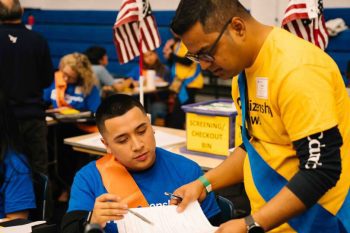 When Max Romero walked into the seminar, he already had valuable experience from his previous immigration work in Jackson Heights, Queens. Max was passionate and motivated to right the wrongs he had seen. Professor Calvo’s seminar pushed him to think beyond individual cases toward systemic reform. The course encouraged him to explore the historical roots of immigration challenges, leading to his research on the 1980s amnesty program.
“The Immigration Reform and Control Act (IRCA) was a three-legged stool — legalization, increased security and border enforcement, and sanctions imposed on employers who knowingly hired undocumented workers. That’s what got it to pass,” Max explains. “But the INS and Congress worked to water down the effects of the legalization component and blocked what could’ve been a transformative legalization program into an under-inclusive legalization program that created many mixed-status families.”
Working with high volumes of detained immigration cases gave Max firsthand insight into some of the many barriers undocumented immigrants face: fear and distrust in the immigration system and its enforcement agencies, need for translation services, and lack of access to benefits. The seminar helped him develop nuanced policy recommendations that acknowledge political realities while advocating for comprehensive reform.
For Max, CUNY Law’s experience-based approach made all the difference: “I feel that CUNY is one of a kind in the approach that it takes to its legal education… it teaches us how to view people not just as clients, but as ordinary human beings.”
His experience demonstrates how the seminar connects direct service work with broader advocacy: “Then what excuse do we have for denying status to people who’ve been here, contributed to our society, and lived by the rules? They deserve a better life.”
Tenzin Choedon
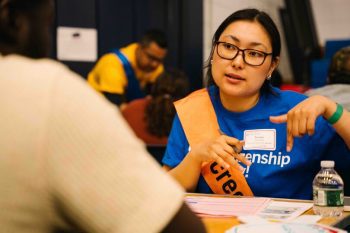 As a first-generation college student who navigated the naturalization and immigration process alongside her father, Tenzin Choedon brought a personal perspective to the practicum. The course allowed her to examine familiar personal territory through a legal lens, analyzing how immigration and citizenship policies create barriers for families and communities.
“We were reading about agency policies, not just what Google says, but also the human impact,” Tenzin reflects. The practicum’s hands-on component was particularly powerful for her: “When you’re at the event, you’re seeing the impactful result—tangibly. That’s what made it so powerful for me.”
Through the course, Tenzin worked on projects that highlighted inadequacies in the naturalization process, particularly around language and cultural barriers. Her experience navigating nonprofit assistance programs with her father informed her understanding of how community support systems can make the difference between success and failure in the immigration and citizenship process.
For Tenzin, the combination of theory and practice was transformative: “You’re in the classroom learning the law, and then you are part of the tangible result. That’s powerful.” For Tenzin, the practicum exemplified what she sees as the heart of justice work: “It connected doctrine to policy and policy to people — that’s where justice work really starts.”
Her recommendation to future students captures the practicum impact: “I want to recommend future students to definitely take the practicum, because I had a pleasant experience… not just learning the law, but seeing its impact in real life.”
Taylor Share
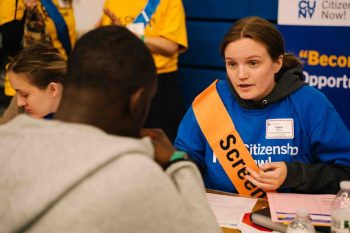 Taylor Share entered the seminar motivated by harmful immigration rhetoric during the Trump administration and her connections with first-generation Americans at Brooklyn College. The course channeled this motivation into concrete advocacy work, particularly around disability accommodations in the naturalization process.
Working on the complexities of the N648 form (a document that provides medical exemptions for naturalization requirements) Taylor discovered how bureaucratic obstacles compound immigration challenges. Her work led to specific policy recommendations: provide clear guidance for applicants and agents, expand the list of professionals who can certify disabilities, and require sensitivity training for USCIS officers.
“Going into the seminar, I knew things were bad, but ending the seminar, I understand how bad they are. Our immigration system is really like a legal obstacle course for regular citizens to navigate as they try to make a living for their families,” Taylor reflects.
Yet the experience also revealed the power of community support and advocacy. Participating in citizenship events showed her the transformative impact of affirming people’s belonging: “It was so beautiful — the way the volunteers told applicants, ‘You do belong in this country.'”
The seminar helped Taylor find her place in immigration advocacy: “I started the semester thinking, ‘I want to do immigration, but I’m not sure if I belong here.’ And it just ended in a way of like — this is exactly where we all belong, actually.”
Experience is Everything: CUNY Law’s Practical Approach
Professors Calvo and Bloom’s practicum captures what distinguishes a CUNY Law education: one where students engage with urgent social issues through direct service, legal and policy analysis.
Max captures the valuable preparation this approach provides: “To think that this is only my second year and Professor Calvo and Professor Bloom have put us in a place where we got right into the deep end. That was a unique experience. It taught me how to connect and help different people.”
The focus on “changing law, policy and practice” ensures that students graduate not just with legal knowledge, but with practical experience responding to complex, evolving challenges, which is exactly the kind of adaptive thinking required in immigration and citizenship law and public interest advocacy.
Courses like the Citizenship Practicum continue CUNY Law’s core promise: preparing lawyers who understand the law and the people it impacts and who are ready to serve from day one.