This signature initiative by the Student Affairs and Enrollment Management division kicks off at the start of summer and extends beyond incoming student orientation to include the campus community of all students, faculty, and staff in a series of related events. Designed to foster inclusive dialogue across disciplines and connect our community, the Common Read explores themes of social justice advocacy. We invite you to join this opportunity to bridge classrooms, perspectives, and experiences.
2026 – 2027 Selection
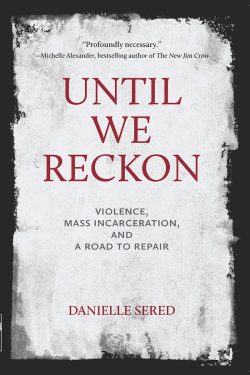
Until We Reckon: Violence, Mass Incarceration, and a
Road to Repair
by Danielle Sered
Danielle Sered, the executive director of Common Justice and renowned expert on violence, offers pragmatic solutions that take the place of prison, meeting the needs of survivors and creating pathways for people who have committed violence to repair harm. Critically, Sered argues that reckoning is owed not only on the part of individuals who have caused violence, but also by our nation for its overreliance on incarceration to produce safety—at a great cost to communities, survivors, racial equity, and the very fabric of our democracy.
Sered asks us to reconsider the purposes of incarceration and argues persuasively that the needs of survivors of violent crime are better met by asking people who commit violence to accept responsibility for their actions and make amends in ways that are meaningful to those they have hurt—none of which happens in the context of a criminal trial or a prison sentence.
About the Author

Danielle Sered
Danielle Sered envisioned, launched, and directs Common Justice. She leads the project’s efforts locally and nationally to develop and advance practical and groundbreaking solutions to violence that advance racial equity, meet the needs of those harmed, and do not rely on incarceration. Before planning the launch of Common Justice, Danielle served as the deputy director of the Vera Institute of Justice’s Adolescent Reentry Initiative, a program for young men returning from incarceration on Rikers Island. Prior to joining Vera, she worked at the Center for Court Innovation’s Harlem Community Justice Center, where she led its programs for court-involved and recently incarcerated youth.
Upcoming Events
Discussions and events for the entire CUNY Law community will be announced throughout the year and listed here.
2026 – 2027 Common Read Runners-Up
“In 2019, author John Green met Henry Reider, a young tuberculosis patient at Lakka Government Hospital in Sierra Leone. John became fast friends with Henry, a boy with spindly legs and a big, goofy smile. In the years since that first visit to Lakka, Green has become a vocal advocate for increased access to treatment and wider awareness of the healthcare inequities that allow this curable, preventable infectious disease to also be the deadliest, killing over a million people every year.
In Everything Is Tuberculosis, John tells Henry’s story, woven through with the scientific and social histories of how tuberculosis has shaped our world—and how our choices will shape the future of tuberculosis.”
In the first of the book’s three intertwining essays, Coates, on his first trip to Africa, finds himself in two places at once: in Dakar, a modern city in Senegal, and in a mythic kingdom in his mind. Then he takes readers along with him to Columbia, South Carolina, where he reports on his own book’s banning, but also explores the larger backlash to the nation’s recent reckoning with history and the deeply rooted American mythology so visible in that city—a capital of the Confederacy with statues of segregationists looming over its public squares. Finally, in the book’s longest section, Coates travels to Palestine, where he sees with devastating clarity how easily we are misled by nationalist narratives, and the tragedy that lies in the clash between the stories we tell and the reality of life on the ground.
In a dazzling series of lectures from her tenure as a professor at Princeton University, Toni Morrison interrogates America’s most famous works and authors, drawing a direct line from the Black bodies that built the nation to the Black characters that many of the country’s canonical white writers imagined in their work. Morrison sees these fictions as a form of creation and projection, arguing that they helped manufacture American racial identity—these “Africanist” presences are “the shadow that makes light possible,” as Morrison writes, and the reflections of their authors’ own deepest fears, insecurities, and longings.
With profound erudition and wit, Morrison breaks wide open the American conception of race with energetic, enlivening readings of the nation’s canon, revealing that our liberation from these diminishing notions comes through language. “How,” Morrison wonders, “could one speak of profit, of economy, of labor, or progress, of suffragism, or Christianity, of the frontier, of the formation of new states, the acquisition of new lands . . . of practically anything a new nation concerns itself with—without having as a referent, at the heart of the discourse or defining its edges, the presence of Africans and/or their descendants?”
Learn the practical skills that can help you build bridges, heal relationships, and engage in productive conversation about even the hardest topics.
Imagine turning what could be a contentious conversation with a family member, a friend, or a coworker into a fruitful exchange that enlightens everyone’s minds and inches both of you toward a solution. Steven T. Collis, one of the world’s leading experts on civil discourse, reveals ten practical habits that can help you navigate the potential minefields of hard topics and leave you and those you converse with feeling thoughtful and productive.
Most people have experienced the slippery slope of dialogue that descends into polarized argument. We yell at each other. We gaslight. We twist one another’s words and meanings. We embrace facts that support our conclusions and ignore those that don’t. Or we sit in silence, afraid to discuss anything of substance. If how you treat others matters to you, this book offers powerful new habits that can give you the confidence to engage in dialogue about hard topics while building and strengthening relationships.
Learn successful habits that will allow you to, among other things:
- Reframe conversations to make them more productive
- Engage in real learning by breaking free from technological manipulation
- Ask questions of others to understand their true motivations
- Recognize gaslighting and not allow it
- Know when and how to use humor
- Take time for long reflection
- Embrace the discomfort of non-closure
Whether you’re motivated by a desire for more fruitful discussions about politics or simply bringing more peace to your home, Habits of a Peacemaker offers you the tools to engage in constructive and healthy dialogue.
Previous Common Reads
2025 - 2026 Selection
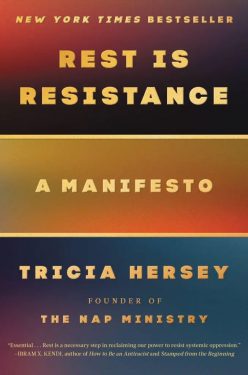
Rest Is Resistance: A Manifesto
by Tricia Hersey
“What would it be like to live in a well-rested world? Far too many of us have claimed productivity as the cornerstone of success. Brainwashed by capitalism, we subject our bodies and minds to work at an unrealistic, damaging, and machine‑level pace –– feeding into the same engine that enslaved millions into brutal labor for its own relentless benefit.
In Rest Is Resistance, Tricia Hersey, aka the Nap Bishop, casts an illuminating light on our troubled relationship with rest and how to imagine and dream our way to a future where rest is exalted. Our worth does not reside in how much we produce, especially not for a system that exploits and dehumanizes us. Rest, in its simplest form, becomes an act of resistance and a reclaiming of power because it asserts our most basic humanity. We are enough. The systems cannot have us.
Rest Is Resistance is rooted in spiritual energy and centered in Black liberation, womanism, somatics, and Afrofuturism. With captivating storytelling and practical advice, all delivered in Hersey’s lyrical voice and informed by her deep experience in theology, activism, and performance art, Rest Is Resistance is a call to action, a battle cry, a field guide, and a manifesto for all of us who are sleep deprived, searching for justice, and longing to be liberated from the oppressive grip of Grind Culture.” Hachette Book Group
2024 - 2025 Selection
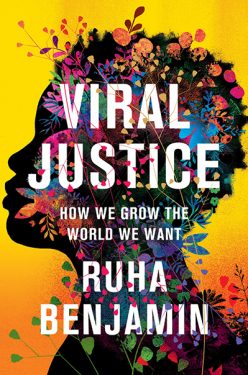
Viral Justice: How We Grow the World We Want
by Ruha Benjamin
“By using viral justice, we can connect the dots between various types of harm; from police violence to viruses, dissecting stressors and oppressors that lead to premature death. The only way we can change things is if we join together as a collective and, through small acts, create our own viral justice.”
“Part memoir, part manifesto, Viral Justice is a sweeping and deeply personal exploration of how we can transform society through the choices we make every day. […] A passionate, inspiring, and practical vision of how small changes can add up to large ones, Viral Justice details how transforming our relationships and communities helps us build a more just and joyful world.” Princeton University Press