
Leading scholar of Critical Race Theory met with students, faculty, and staff to examine how history, doctrine, and lived experience shape academic programs and institutional identity
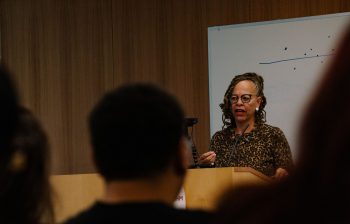
Professor Cheryl Harris addresses the CUNY Law community
On November 19, CUNY School of Law welcomed Professor Cheryl Harris of UCLA Law for a campus-wide conversation on how an understanding of the long history of how racism has shaped the law can help us better understand and face the current political crisis. Harris, a leading scholar of Critical Race Theory whose work has influenced generations of legal thinkers, engaged students, faculty, staff, and alumni in a wide-ranging discussion of the interpretive frameworks that continue to guide contemporary legal analysis. Her visit offered the community an opportunity to examine how theory, history, and lived experience converge in shaping legal structures and professional judgment.
Organized by the Professional Development Committee, the Critical Race Theory Subcommittee and the Office of Academic Affairs, the event featured both a public conversation and a faculty–staff round table that examined CUNY Law School’s roots and ongoing commitment to ensure that the way we teach law draws meaning from the histories and social conditions that surround it. The round table also opened a broader conversation about how an approach to the law that centers the experiences of those most marginalized can inform the institution more comprehensively, from curriculum design to the school’s public messaging, in ways that reflect CUNY Law’s commitment to understanding law in relation to history and lived experience. For students preparing to enter a profession marked by rapid shifts in policy, politics, and public life, the clarity of that message resonated and offered a sense of what it means to approach legal questions with analytic precision.
Her visit also underscored a defining feature of CUNY Law’s academic program. The curriculum is built on the understanding that law must be studied in context and that students learn best when they can trace how rules emerge from real-world experience and reflect current allocations of power. This focus on how those most impacted experience the law and attention to how the distribution of power shapes the law informs the first-year sequence and extends into the clinics, where students examine the systems they study by working directly with clients and communities. Faculty scholarship and teaching reinforce this model by drawing on social movements, historical research, and community-based insights that illuminate the conditions in which legal doctrine operates.
Harris reminded students that legal analysis is not an abstract exercise. It is a method for seeing how power functions and how it might be redirected. She encouraged them to view the law as a tool that can confront inequity and build more accountable institutions. Her visit affirmed the academic commitments that define CUNY Law and the intellectual environment the school seeks to cultivate for future lawyers.