
On December 30, 2025, Governor Kathy Hochul granted clemency to two people in New York State.
Only two.
For Andy Ratto, Christopher Alford, Rina DeFrancesco, and Michelle Hernandez, the students in CUNY Law’s Defenders Clinic and its Second Look Project, the news came after months of work that allowed little margin for error. More than 1,000 clemency applications were pending at the time, many involving people serving decades-long sentences. Yet across the entire year, only two individuals were granted relief that would allow them to appear before the New York State Board of Parole years earlier than their original sentences permitted.
Both men—Raphael Jackson, 53, and Terrance Cole, 59—worked with students and alumni of CUNY School of Law, in an alignment of client advocacy, clinical training, and reform strategy that CUNY Law has helped lead in New York and on the national stage.
The Work Behind a Clemency Application
Clemency is one of the few mechanisms in New York that can create a path toward immediate release or early parole consideration for people serving extreme sentences where other avenues are limited. On paper, the process appears straightforward: submit an application and supporting materials. In practice, it demands the careful construction of a complete and credible record, one that can carry legal, factual, and emotional weight at once.
For CUNY Law students, that meant developing submissions strong enough to stand in a process where outcomes are rare and timelines uncertain, while adhering to the clinic’s commitments to accuracy, restraint, and disciplined advocacy.
Raphael Jackson
According to the Governor’s office, Raphael Jackson was convicted of two counts of Criminal Possession of a Weapon in the Second Degree and sentenced to 16 years to life. Over the course of his incarceration, Mr. Jackson has sustained engagement and responsibility within the prison community, including serving as a chaplain’s clerk and working in the prison law library, assisting others with legal research and filings.
Jackson’s clemency application was prepared by Defenders Clinic students Andy Ratto, Christopher Alford, Rina DeFrancesco, and Michelle Hernandez, who worked with him to assemble a record that documented his conduct, contributions, and readiness for review.
“As part of training to be a public interest lawyer, we are taught that our clients are the experts on their own lives,” shares Andy Ratto. “As lawyers, we are advising them, but ultimately, they are in charge of their case, and we are working for them. With Mr. Jackson, this dynamic was even more pronounced because of his experience working in the law library in prison.”
While Ratto knew he and his classmates had worked hard and done all they could, “hitting the send button on the email to the Governor’s clemency staff is a scary and stressful moment. Our client’s freedom is literally on the line, and any mistake we have made as students in the Defenders Clinic could cause our client to remain unnecessarily and unjustly imprisoned.”
But, he is quick to add, “With Mr. Jackson’s application, I felt confident about the submission because we had crafted the materials in consultation with him, and he had reviewed the final version with a fine-toothed comb before signing off on it.”
Terrance Cole
According to the Governor’s office, Terrance Cole was convicted of four counts of Burglary in the Second Degree and sentenced to 20 years to life. A U.S. Air Force veteran, Mr. Cole pursued educational opportunities and earned an associate degree while incarcerated. Under the terms of his original sentence, he would not have been eligible to appear before the Parole Board until 2034.

Nat Baker ’21, Second Look Project Fellow and Attorney
“Governor Hochul’s decision to show mercy to Mr. Terrance Cole returns to our community a philosophy-loving veteran with valuable insights and a generous heart,” says Nat Baker ’21, a Defenders Clinic alum and current Legal Fellow and attorney with the clinic’s Second Look Project. “We are all better for it. Still, the moment is bittersweet, as countless others like Mr. Cole continue to languish behind bars—at great cost to our collective humanity.”
For Baker, working on a clemency application clarified the depth and responsibility of this form of advocacy. “Before I worked on my first clemency application in the Defenders Clinic, I did not understand how intimate this work is. A strong clemency application requires you to become the client’s biographer, confidante, and advisor. The power and responsibility of those roles is obvious, but less apparent is the trust and respect you must earn over time from your client before you can do that work with excellence.”
That work often takes months, and sometimes years. Baker notes that building a complete clemency record requires persistent effort to obtain institutional files, personal records, and corroborating documentation, along with a careful effort to understand how clemency decision-makers assess rehabilitation, responsibility, and readiness for release.
“I’ve learned that I cannot merely assemble whatever collection of documents is provided to me and call it a clemency application. After all,” Baker remarks, “work of that perfunctory quality is usually what got our clients a ridiculously long prison sentence to begin with.”
CUNY Law’s model of client-centered lawyering places trust-building at the core of this process. “I need to be informed about things I don’t even know I’m missing information on,” Baker says. “The only way I’ve ever received that information is through lengthy, meaningful dialogues over time, as the client and I truly get to know each other. Long-buried memories are recalled, painful details are entrusted, and connections between previously disconnected events are made. I believe these details that lurk beneath the surface are what make a clemency application airtight.”

Yohannes Johnson, who goes by Knowledge, worked with the Second Look Project and now lives with a fellow member of the Bulls Head Meeting in Saugerties. (Photo by Eloise Goldsmith)
Beyond Clemency: When Review Depends on Exception
Recent coverage of the Defenders Clinic and the Second Look Project’s clemency work centers people whose applications were no less careful, no less supported, and no less grounded in evidence of transformation, but who remain incarcerated. Reporting by The City followed the Clinic’s clemency efforts on behalf of Ramon Henriquez and Darryl Powell, both of whom received rare institutional support for sentence commutation, including from prosecutors, yet were left waiting alongside hundreds of others when only two applications were granted relief. Additional reporting has highlighted the clemency application submitted by Defenders Clinic students Cierra King and Zahra Thani on behalf of Shawn Peace, as well as the long arc of advocacy that ultimately led to Yohannes “Knowledge” Johnson’s release after decades in prison, assisted through work carried forward by CUNY Law students across multiple graduating classes. Together, these stories underscore what the numbers alone cannot: clemency applications represent years of human growth, accountability, and hope, even when executive action does not follow.
The commutations granted to Jackson and Cole were issued through executive clemency, an extraordinary form of relief that operates outside a regularized system of judicial review. In practice, clemency is exceptional—available to many but granted to far too few.
“While completing Mr. Jackson’s application, I learned about the many other clients my 19 classmates were working on. Each of these other clients was as deserving of clemency as Mr. Jackson,” shares Rotto. “The reality is that when Governor Hochul is the sole source of hope for these individuals to seek relief for their lengthy and unjust prison sentences, then the vast majority of them will be relegated to languishing behind bars.”
That reality is part of why sentencing reform advocates and the Defenders Clinic’s Second Look Project are pushing for Second Look legislation, which would create a lawful pathway for courts to reconsider long sentences after individuals have demonstrated rehabilitation.

Professor Steve Zeidman hosts Prison journalist John J. Lennon joined virtually to discuss his new book, The Tragedy of True Crime: Four Guilty Men and the Stories That Define Us
In New York, the Second Look Act (S.158 / A.1283) would authorize anyone who has served at least ten years – regardless of their original sentence or crime of conviction- to apply for a sentence reduction. The proposal has gained increasing attention, including public support from New York’s Chief Judge Rowan Wilson, who referenced the need for Second Look legislation in his 2025 State of the Judiciary address.
For Professor Steve Zeidman, the connection between individual clemency advocacy and broader reform is central to the clinic’s work. While there is national recognition of the crisis of mass incarceration, little is being done to address that crisis.
“A sentence once imposed, even if seemingly just at that time, does not remain just, necessary, or appropriate in perpetuity,” notes Zeidman. “Since its inception, the Second Look Project has received over 3,000 requests for help from people serving massive ‘death by incarceration’ sentences in New York State prisons. And while the SLP continues to push the Governor to use her vast clemency power in far greater numbers, more must be done to recognize and value the inherent capacity in each of us to grow and change. The Second Look Act is a major step toward that goal.”
 Convening New York’s Leaders on Second Look
 Convening New York’s Leaders on Second Look
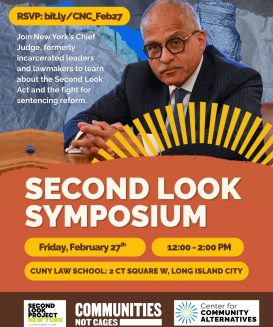
CUNY Law will also serve as a convening site for this conversation. On Friday, February 27, 2026 (12:00–2:00 PM ET), the Law School, in collaboration with Communities Not Cages, will host a Second Look Symposium. Details about the event, which is open to the public, and the link to register can be found in the linked event post.
The Symposium will bring together New York’s Chief Judge, Deputy Senate Majority Leader Michael Gianaris, Professor Steve Zeidman, and formerly incarcerated leaders to examine the future of sentencing review and the Second Look Act in New York.
What This Work Makes Possible
As a result of the work done by CUNY Law clinic students, Raphael Jackson and Terrance Cole now have the opportunity to appear before the New York State Board of Parole years earlier than their original sentences would have allowed.
For the students who helped build their applications, the work is a lesson in what careful advocacy can do, as well as a reminder of why New York needs durable sentencing review mechanisms that do not depend on the rare alignment of executive action and exceptional cases.